Let’s start with the boring but important part. Your data on sales, prices, promo, shelf and shopper behaviour is usually scattered across different systems and reports. We bring it under one roof, clean it and put it in order. We take that on; you simply hand over the data as it is. And we don’t start every project from scratch: a ready-made core of proven commercial logic and tested algorithms helps reach the first conclusions faster and more accurately. And then comes the part that drives growth.
Artificial intelligence, the kind everyone knows from chatbots (large language models, LLMs), works like a polymath with a broad outlook. It assembles your scattered reports into a single picture, explains conclusions in plain language and points to what has already worked in other markets: the world’s best practices and trends.
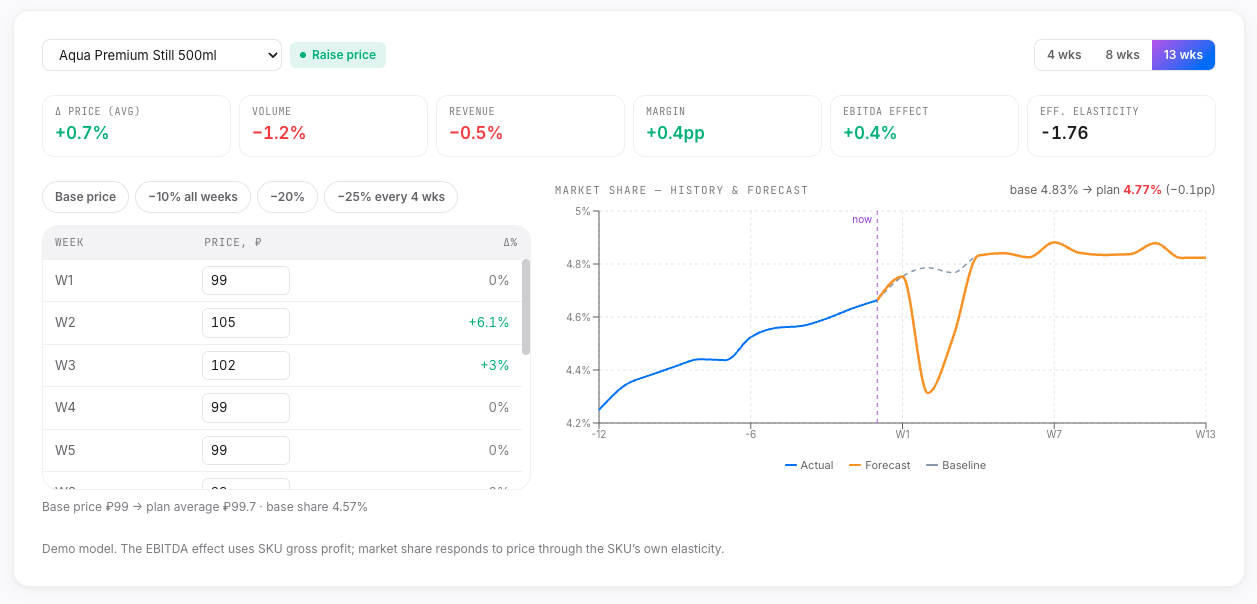
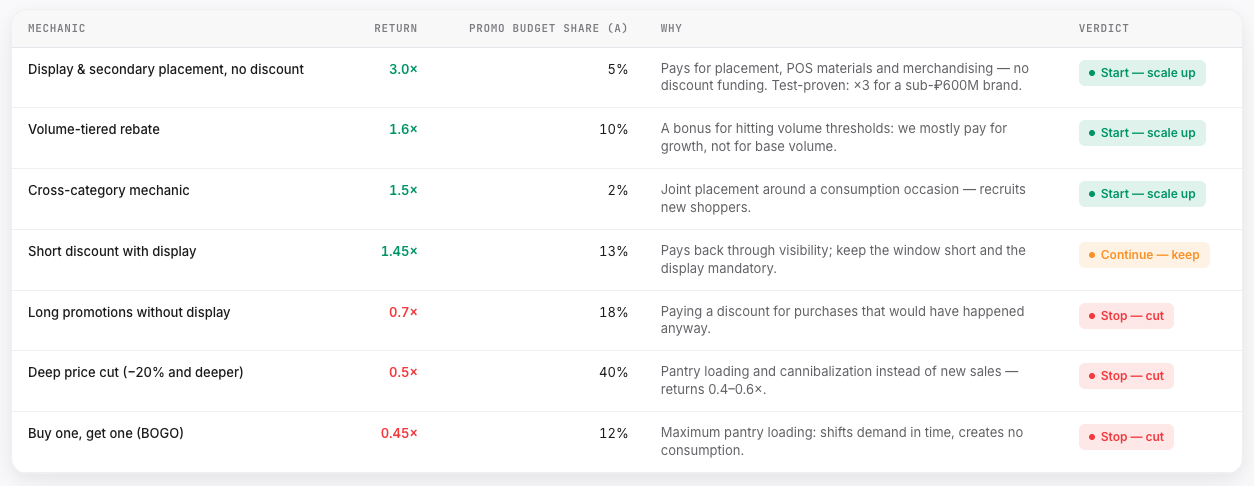
But a broad outlook doesn’t calculate your profit. That is the job of machine learning (ML), a narrow specialist trained specifically on your data. Inside each tool it calculates precisely and concretely: where to raise price without losing sales (price elasticity), which promo actually pays off (promo returns), what really drives your sales (a multi-factor model, econometrics). With every data refresh it makes fewer errors.
These models not only explain the past, but also play out the future: what happens to profit if you raise price by 5% or shift the promo budget between brands. You compare scenarios and see the likely outcome before you invest. This is scenario modelling, and you can try it yourself.
And yet the final word stays with the human. The expert checks the calculation against the reality of the market and the context that doesn’t show up in the numbers, and turns it into a commercial decision the team is accountable for – not the algorithm.
Together these three layers deliver what you can’t get separately: you make decisions faster, see your business more clearly and get concrete steps, not just charts. And the heavy computation runs on your data inside a secure perimeter. We don’t pour your numbers into someone else’s chatbot.
The system is modular: you can start with one task (a single tool, brand or retail chain) and expand as data and business priorities grow. More in the “What we do” section.
In short
Artificial intelligence (LLM) connects context and explains it in plain language. Models (ML) calculate precisely on your data and show where different decisions lead. Experts turn this into decisions you can explain and defend before the retail chain, finance and the team. It is exactly this combination that gives the whole system its meaning.